 Welcome from the Bendigo Family Study. This week we commence recruitment.
The Bendigo Family Study is Australia's largest tri-generational study of rural healthcare. Our team, lead by Clinical Professor Julie Quinlivan and associate investigators Dr Rodney Petersen, Dr Nicola Yuen, Dr Aimee Waegele, Dr Adela Lourensz, Dr Emma Adams and Dr Yong Shi Zhang will be exploring how we can improve healthcare outcomes for rural Australians. Rural health services face unique challenges relating to distance and availability of healthcare personnel that are not faced by metropolitan health services. A detailed snapshot of the rural experience of new families can help identify issues and lead to service improvements. This snapshot study will focus on several key themes: 1. Access to information How do rural families access information about healthcare concerns and the availability of services. Are they able to access reliable information from healthcare professionals or do they rely on the internet or friends and family? How does anxiety or distance play a role in access? We will be replicating an innovative international study to explore how the internet is changing the healthcare landscape. 2. Prepared for care Do rural women presenting for maternity care arrive in a timely manner with all relevant investigations completed so care can be optimally advanced? Commonwealth and State governments regularly review the recommended antenatal investigations for normal pregnancy. Observational experience suggests that many pregnant women presenting for hospital care have not had the recommended investigations, and in other cases, have had investigations not recommended for care. Presenting to hospital with optimal investigation is a key measure of the quality of healthcare. We will use pregnancy as the model to evaluate how prepared rural Australians are for hospital care. 3. Prepared for discharge The length of stay in hospital is falling as efficiencies in care ensure streamlined checks for safe discharge. However, rural families may be discharged to remote locations where a lack of access to local services may impact on patient's confidence to access care. We will be evaluating preparedness for hospital discharge using new parents and babies as the model. New families share concerns of all patients leaving hospital, and also have additional concerns relating to the role of being parent to a newborn. Common unique concerns centre around access to postnatal midwifery, child health, breastfeeding, postpartum physical and mental health services. We will be exploring how to improve preparedness for discharge. 4. Managing chronic disease in the community in diverse multigenerational families. Many studies look at a patient with a chronic disease in isolation, when management of chronic disease is affected by wider family and community circumstances. We will explore chronic disease management in rural Australia by taking a tri-generational approach and integrate newborn, parenting and grandparent outcomes to see how well we are supporting our rural families. 5. Other subsidiary studies Our study will also explore attitudes to topical areas in medicine and focus on the emerging areas of genetic testing, the move to a society that seeks answers through the internet, and living with chronic disease. Our team will commence recruiting this week and we plan to formally launch our study in June 2024. If you would like to be involved then please don't hesitate to reach out to one of our team. Regards Professor Julie Quinlivan Chief investigator Bendigo Family Study
0 Comments
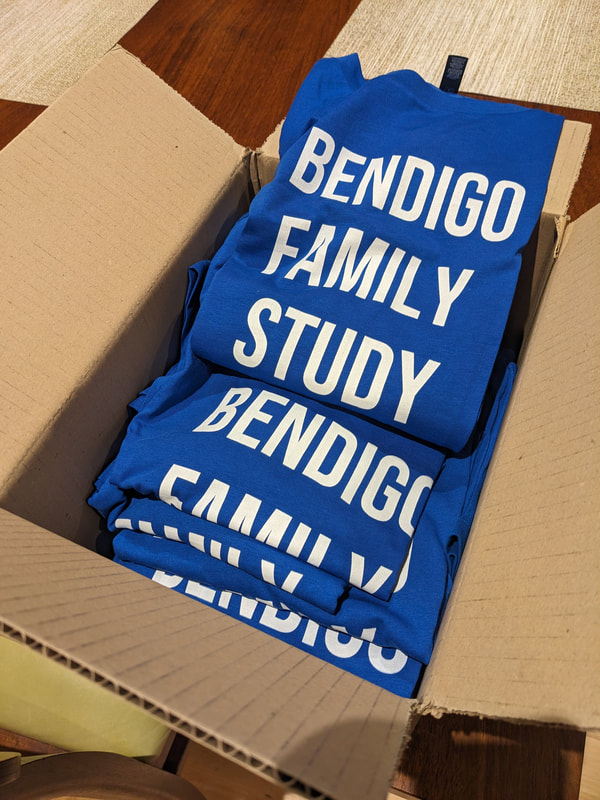 Great news as our study T-shirts were delivered from the printers.
Next to be printed will be all our questionnaires for new mums, partners and grandparents, along with their consent forms. We will also be printing our advertising posters. We are also finalising our data set for entering study data. We hope to start with a few pilot recruits in the next month before a formal launch and our main recruitment drive commences. Best wishes Professor Julie Quinlivan Chief investigator Great news!
The Bendigo Family Study has received ethics approval from the Victorian Government Bendigo Health Service ethics committee. We are now arranging to print our team T shirts and our consent forms, posters and questionnaires ready to launch and start recruiting. Our offical ethics approval code is Bendigo Family Study 103372 HREC/103372/BH-2024-417877(v3) The Bendigo Family study is unique as it will address trigenerational family health from new borns, parents and grandparents to create a snap shot of family life in rural Australia. We are covering many areas of health and social wellbeing, including pregnancy care, mental health, parenting, enhancing hospital care and managing chronic diseases in rural Australia. We hope our results will achieve service improvements for rural Australians. Bendigo is a great place to centre this study. Bendigo is the fourth-largest inland city in Australia and the fourth-most populous city in Victoria according to Wikipedia (https://en.wikipedia.org/wiki/Bendigo). It has an important history in agricultural sheep industry and the gold rush era of Australia and is a long standing important region for the traditional owners of the area who are the Dja Dja Wurrung (Djaara) people.. It is one of Australia's great inland historic cities. Please become involved in this study. Enrole as a participant or consider helping to advocate and advertise the study to your community. Look out for our study launch next Month! Professor Julie Quinlivan Bendigo Family Study lead investigator The Bendigo Family Study has now been registered with the Australian and New Zealand Clinical Trials registry with the number ACTRN12624000240549p
We have submitted our trial for ethics review and are in the process of designing our promotional materials. We hope to commence recruiting in the middle of the year. In the next series of posts we plan to provide more information on each of our planned subsidiary studies. We also recently presented findings from our Australian Fathers Study in Christchurch NZ and the key findings indicated that new fathers experience postnatal depression at similar rates to those seen in new mothers. We plan to explore this same concern in our rural cohort of new fathers in Bendigo, who may also face issues with distance and lack of access to care. If you are interested in reading more about our Australian Fathers Study then visit our website at https://www.australianfathersstudy.com/ Professor Julie Quinlivan Lead investigator Bendigo Family Study  The Bendigo Family Study will be one of Australia's largest tri-generational studies into rural families with our focus extending from newborns, to their parents and grandparents.
We are keen to improve the delivery of services to Australian rural communities and have selected the fabulous City of Bendigo as our base. Our research team consists of six local clinicians and a research expert. Rural health services face unique challenges relating to distance and availability of healthcare personnel that are not faced by metropolitan health services. Our detailed snapshot of rural health will be adopting a tri-generational focus to help identify key issues in rural healthcare delivery with the aim to achieve service improvements. Within the Bendigo Family Study project we have four major sub-studies. These are: 1. Access to healthcare information. 2. Prepared for parenting. 3. Prepared for hospital discharge. 4. Managing chronic disease in our community. We also have other pre-planned subsidiary studies to explore attitudes and advances in healthcare. Our study will focus on new and growing families by recruiting new mothers who have just delivered a baby, and via these mothers, invite extended family members (being their partner and a grandparent) to participate in a survey. Our target is 1500 individuals from 500 families. We have now completed consultation and have our questionnaires finalised. The next step is to secure independent ethical review of the project and trial registration. We will be registering this study in the Australian and New Zealand Clinical trials system. More soon... |
Bendigo Family Study teamWe are a team of healthcare professionals running one of Australia's largest intergenerational rural family studies from the fabulous City of Bendigo. Scroll down to read our blog and click on menu to learn more about the study. Archives
May 2024
Categories |
 RSS Feed